
UV Printer Applications: 50+ Products You Can Print & Sell
Discover 50+ profitable products you can create with a UV printer. From phone cases and promotional items to home décor and custom packaging — explore every UV printing application and business opportunity.
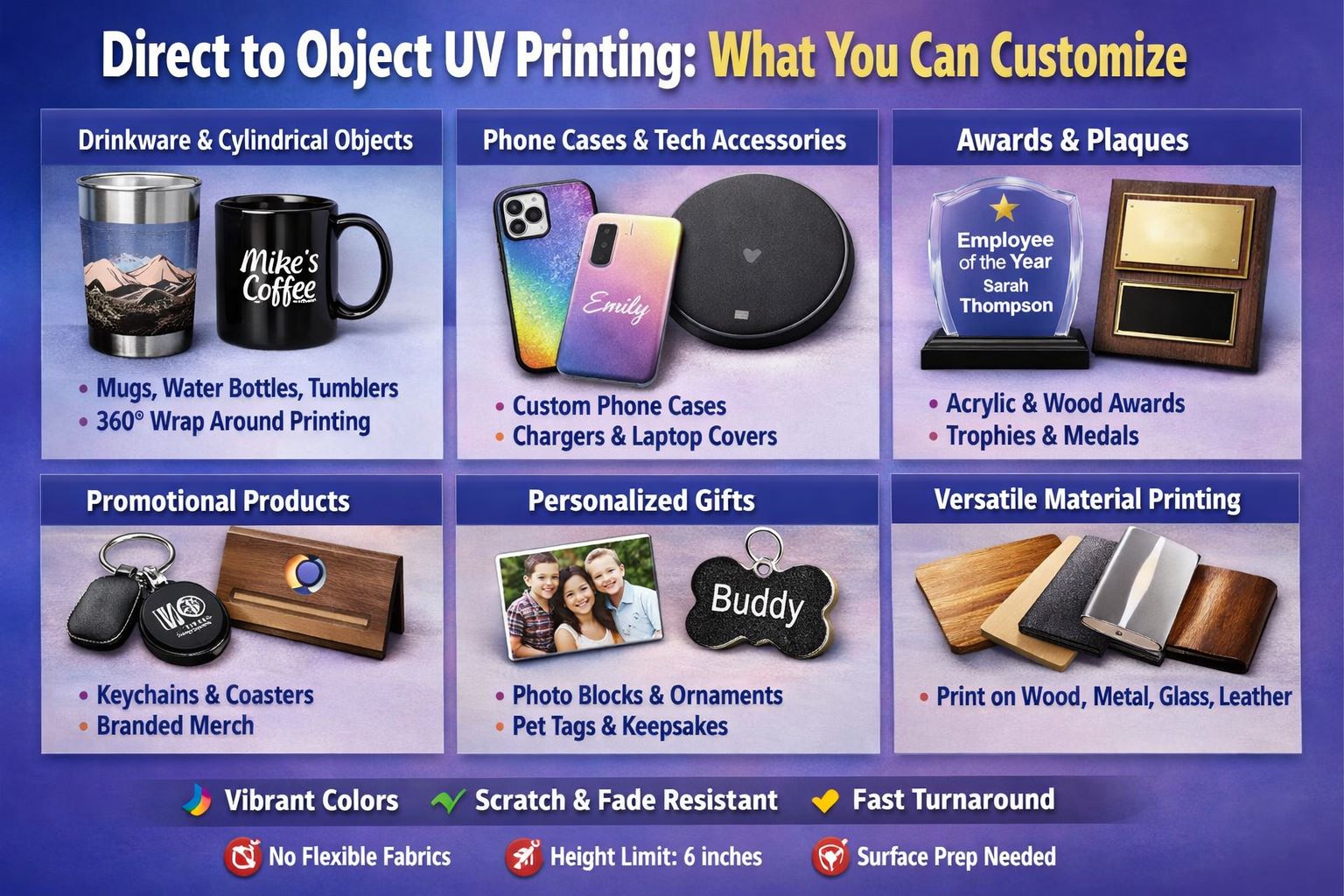
One of the most powerful advantages of UV printing technology is its incredible versatility. Unlike traditional printing methods limited to paper or fabric, a UV printer can print directly on virtually any flat or cylindrical surface — glass, metal, wood, plastic, leather, ceramic, acrylic, and dozens more materials.
This opens up a world of business opportunities. Whether you’re starting a custom products business, adding personalization services to an existing shop, or exploring new revenue streams, understanding the full range of UV printer applications is essential for maximizing your investment.
In this comprehensive guide, we’ll explore 50+ products you can print and sell with a UV printer, organized by category. For each category, you’ll learn what products sell best, profit potential, and tips for success.
1. Phone Cases & Tech Accessories
Custom phone cases remain one of the most popular and profitable UV printing applications. The phone accessories market is projected to exceed $280 billion by 2025, with personalized cases commanding premium prices over generic options.
Products You Can Create
- Custom phone cases (iPhone, Samsung, Pixel, etc.)
- Tablet and iPad cases
- Laptop skins and covers
- AirPods and earbuds cases
- Power banks (custom branded)
- USB drives and flash drives
- Wireless chargers
- Mouse pads (hard surface)
Profit Potential: Phone cases cost $1-3 to produce and sell for $15-35, offering 70-80% profit margins. High-volume sellers on Etsy and Amazon report $5,000-15,000 monthly revenue from phone cases alone.
2. Signage & Display Products
Commercial signage represents a high-value B2B market where UV printing excels. Direct printing on rigid substrates eliminates the need for vinyl application, creating more durable, professional-looking signs.
Products You Can Create
- Acrylic signs and nameplates
- Metal business signs
- PVC and foam board displays
- Real estate signs
- Yard signs and political signs
- Point-of-sale displays
- Trade show graphics
- Wayfinding and directional signs
- Safety and compliance signs
- Menu boards (restaurants, cafes)
Profit Potential: Custom acrylic nameplates cost ₹100-150 to produce and sell for ₹500-800. Larger commercial signs command even higher margins with B2B clients.
3. Promotional Products & Corporate Gifts
The US promotional products market exceeds $25 billion annually. Corporate clients order custom branded items for events, employee gifts, and marketing campaigns — often in quantities of 50-500+ pieces.
Products You Can Create
- Branded pens and pencils
- Keychains (acrylic, metal, wood)
- ID badges and lanyards
- Business card holders
- Desk accessories (pen holders, paperweights)
- Coasters (wood, ceramic, cork)
- Magnets (refrigerator, car magnets)
- Luggage tags
- Notebooks and journals (cover printing)
- Award plaques and trophies
Profit Potential: Corporate orders typically have 25-50% markups. A 100-piece keychain order at $5 each (cost: $1-2) generates $300-400 profit from a single order.
4. Home Décor & Interior Design
Interior designers and homeowners pay premium prices for custom décor items. UV printing on glass, wood, and ceramic creates unique pieces that can’t be mass-produced.
Products You Can Create
- Canvas and acrylic wall art
- Glass photo prints
- Wood panel prints
- Ceramic tiles (backsplash, decorative)
- Mirror printing (decorative mirrors)
- Decorative plates and platters
- Vases and flower pots
- Clocks (wall clocks, desk clocks)
- Furniture panels (tabletops, cabinet doors)
- Lampshades
Profit Potential: Custom wall art panels sell for $50-200/sq. ft. Interior design projects with commercial clients can generate thousands in revenue per project.
5. Personalized Gifts & Keepsakes
The personalized gift market thrives year-round with peaks during holidays, weddings, and graduations. UV printing enables unique one-of-a-kind items that customers treasure.
Products You Can Create
- Photo frames (wood, acrylic, glass)
- Wedding favors
- Baby announcement items
- Pet photo products
- Memorial and tribute pieces
- Cutting boards (engraved look)
- Wine boxes and gift boxes
- Christmas ornaments
- Graduation gifts (diploma frames, keepsakes)
- Anniversary and milestone gifts
Profit Potential: Personalized gifts command 40-60% premiums over generic items. Wedding markets alone (2M+ weddings/year in US) offer massive opportunity.
6. Drinkware & Beverage Items
Custom drinkware is one of the hottest product categories. For cylindrical items like tumblers and bottles, you’ll need a 360 rotary UV printer or tumbler printer.
Products You Can Create
- Stainless steel tumblers
- Water bottles (metal, plastic, glass)
- Coffee mugs (ceramic, glass)
- Wine glasses and champagne flutes
- Beer mugs and pint glasses
- Shot glasses
- Travel mugs and thermos
- Flask and hip flasks
- Coaster sets
- Bottle openers
Profit Potential: Custom tumblers cost $6-8 to produce and sell for $20-35. At 60-100 tumblers/hour, you can generate $840-2,700 profit per hour of production.
7. Packaging & Labels
Custom packaging helps small brands compete with big companies. UV DTF printing is especially useful for curved packaging that can’t be directly printed.
Products You Can Create
MTuTech production notes for UV printing applications
For buyers comparing UV printing applications options, the strongest ranking signal is not only the definition of the process. The page should also explain machine fit, production limits, material behavior, ink or fixture requirements, and the next page a buyer should read before requesting a quote.
Best machine fit
Use this guide together with UV Printer when the job requires stable UV output, repeatable setup, and production-ready print quality. If the work involves different shapes, materials, or order sizes, compare it with Flatbed UV Printer 2513 before choosing the final printer.
Production checklist
- Confirm the printable area, part height, and fixture or rotary requirements before quoting the job.
- Match ink, primer, and curing settings to the substrate so adhesion and scratch resistance are predictable.
- Standardize artwork preparation, white ink layers, and test prints before moving into batch production.
- Track production cost by ink use, setup time, rejects, and finishing steps instead of looking only at printer price.
Related MTuTech resources
FAQ
Which MTuTech printer should this article connect to? The best next page depends on the material, shape, and production volume. Flat products usually start with UV printer or UV Printer 9060 pages, while bottles, tumblers, and round products should connect to rotary, cylinder, tumbler, or cylindrical printer pages.
What should buyers check before ordering? Buyers should confirm print size, material compatibility, white ink needs, fixture design, curing performance, maintenance expectations, and whether the workflow supports repeatable production rather than one-off samples only.
- Custom product boxes
- Cosmetic and skincare packaging
- Food packaging (boxes, containers)
- Wine and spirits bottles
- CBD and cannabis packaging
- Supplement and vitamin bottles
- Candle packaging
- Gift boxes and presentation boxes
- Product labels and stickers
- Branded shipping boxes
Profit Potential: Packaging services for small brands offer recurring revenue. A local candle maker needing 500 custom jars/month becomes a steady client.
8. Industrial & Commercial Applications
Industrial UV printing applications are less glamorous but highly profitable. B2B clients need durable prints that withstand harsh conditions.
Products You Can Create
- Control panels and dashboards
- Machine labels and nameplates
- Equipment branding
- Serial number plates
- Warning and safety labels
- Automotive parts printing
- Electronic device housings
- Medical device labeling
- QR codes and tracking labels
- Asset tags
Profit Potential: Industrial clients value durability over price. Control panel printing can command $50-200+ per panel with ongoing reorder relationships.
9. Sports & Recreation Products
Products You Can Create
- Golf balls (custom logos, personalization)
- Baseballs and softballs
- Tennis balls
- Hockey pucks
- Skateboards (deck graphics)
- Helmets
- Fishing lures
- Guitar picks
- Drum sticks
- Musical instrument accessories
10. Fashion & Leather Accessories
UV printing on leather and fashion accessories creates premium products with custom designs that traditional methods can’t achieve.
Products You Can Create
- Leather wallets
- Belts
- Handbags and purses
- Watch bands
- Sunglasses (temple printing)
- Jewelry boxes
- Hair accessories
- Shoe accessories
Materials You Can Print On
UV printers work on virtually any rigid material. Here’s a quick reference:
| Material | Best Products |
| Acrylic | Signs, keychains, awards, displays, photo frames |
| Glass | Awards, photo prints, drinkware, vases, mirrors |
| Metal | Signs, tumblers, nameplates, promotional items |
| Wood | Wall art, cutting boards, signs, gift items |
| Plastic | Phone cases, packaging, promotional items, toys |
| Ceramic | Mugs, tiles, plates, decorative items |
| Leather | Wallets, bags, belts, accessories, journals |
| PVC/Foam Board | Signs, displays, trade show graphics |
Tips for Building a Profitable UV Printing Business
- Start with one niche: Master phone cases OR tumblers OR signage before expanding. Focus builds expertise and reputation.
- Test before production: Always test print on sample materials before committing to large orders.
- Build supplier relationships: Quality blank products matter. Source from reliable suppliers with consistent quality.
- Price for profit: Don’t compete on price — compete on quality and uniqueness. 25-50% markup is standard.
- Show your work: Social media videos of printing process attract customers. Short clips perform well on Instagram and TikTok.
- Pursue B2B clients: Corporate orders provide larger volumes and recurring revenue.
- Communicate professionally: Quick responses and clear expectations build customer loyalty and referrals.
Start Creating Products Today
The versatility of UV printing technology means your only limit is creativity. From phone cases and promotional products to home décor and industrial applications, the business opportunities are virtually endless.
Ready to explore UV printing for your business? Browse our complete UV printer collection to find the right machine for your applications. Whether you need a compact desktop printer for phone cases or an industrial flatbed for signage, we have solutions to match your goals.
Frequently Asked Questions
What’s the most profitable product to print with a UV printer?
Phone cases and custom tumblers offer the best combination of high demand, low production cost, and strong profit margins (60-80%). However, B2B applications like signage and corporate promotional products often generate higher total revenue per order.
Do I need special ink for different materials?
Most UV printers use universal UV-curable inks that work across materials. Some surfaces (like certain plastics) may benefit from primers for optimal adhesion. Always test print on sample materials first.
Can I print on curved or cylindrical objects?
Yes, with the right equipment. Flatbed UV printers handle flat items. For bottles, tumblers, and cylinders, you need a rotary UV printer or UV DTF transfers.
How durable are UV prints?
UV-cured prints are highly durable — scratch-resistant, waterproof, and fade-resistant. They typically outlast traditional printing methods and can withstand outdoor conditions for years.
What’s the startup cost for a UV printing business?
Entry-level desktop UV printers start around $3,000-8,000. Mid-range flatbed printers run $8,000-25,000. Industrial models can exceed $50,000. Factor in blanks, ink, and supplies for a complete startup budget.
Commercial Buyer Notes for UV printer applications
This topic matters because buyers looking for sellable product ideas and the machine types behind each application. A post can rank for an informational keyword and still support a commercial page when it answers the practical questions a buyer asks before requesting a quote. For MTuTechPrinter.com, this article should guide readers toward the right production path instead of competing with the main product page.
The best audience for this page is new print businesses, product decorators, US custom merch sellers, and B2B print shops. These visitors are usually not looking for a basic definition only. They want to know whether the workflow fits their products, whether the machine can handle the job repeatedly, and what problems they should avoid before investing in equipment.
Best-fit buyer scenarios
- Phone cases and plaques where buyers care about repeatability, realistic cost per job, and a production process that does not collapse once order volume increases.
- Bottles and tumblers where buyers care about repeatability, realistic cost per job, and a production process that does not collapse once order volume increases.
- Product packaging where buyers care about repeatability, realistic cost per job, and a production process that does not collapse once order volume increases.
- Corporate gifts where buyers care about repeatability, realistic cost per job, and a production process that does not collapse once order volume increases.
- Sample production where buyers care about repeatability, realistic cost per job, and a production process that does not collapse once order volume increases.
Production checks before choosing a printer
- Margin per product should be tested on the same materials, blanks, inks, and finishing conditions the shop will use for paid orders.
- Fixture time should be tested on the same materials, blanks, inks, and finishing conditions the shop will use for paid orders.
- Material repeatability should be tested on the same materials, blanks, inks, and finishing conditions the shop will use for paid orders.
- Ink cost should be tested on the same materials, blanks, inks, and finishing conditions the shop will use for paid orders.
- Buyer demand should be tested on the same materials, blanks, inks, and finishing conditions the shop will use for paid orders.
How This Article Supports the Main Product Pages
The primary commercial path from this article should lead to UV printer. Readers who are comparing related workflows can also review UV DTF printer, 360 rotary UV printer, tumbler printer, UV printing applications. This keeps the blog post useful as an educational asset while passing topical relevance to the commercial pages that should rank for buyer-intent terms.
For search engines, this creates a cleaner hierarchy: the blog post handles long-tail questions, application details, mistakes, workflow checks, and comparison language; the product page remains the main destination for machine specifications, inquiry intent, and conversion. That structure helps reduce keyword overlap and gives Google clearer signals about which page should own the commercial keyword.
Internal linking recommendation
When this article is referenced from future content, use natural anchors such as “UV printer applications”, “commercial UV printer applications workflow”, and “buyer guide for UV printer applications”. Reserve exact commercial anchors for the product page, especially when building external guest posts or high-authority references.
Decision Table for Commercial Use
| Use case | Key check | Why it matters |
|---|---|---|
| phone cases and plaques | margin per product | Use this as a buying signal before choosing the final printer workflow. |
| bottles and tumblers | fixture time | Use this as a buying signal before choosing the final printer workflow. |
| product packaging | material repeatability | Use this as a buying signal before choosing the final printer workflow. |
| corporate gifts | ink cost | Use this as a buying signal before choosing the final printer workflow. |
What Makes This Topic Easier to Rank
The easiest ranking angle is not to repeat broad product-page copy. The stronger approach is to answer specific buyer questions around setup, mistakes, material fit, cost control, workflow, and production risk. Those long-tail topics usually create impressions earlier than broad head terms, especially in the United States where buyers compare several suppliers before contacting a manufacturer.
This article should therefore be used as a support asset: keep the language practical, connect it to real production decisions, and link clearly to the right MTuTech Printer page. Over time, impressions from these long-tail phrases can help the site build topical authority and send more qualified visitors toward the pages that matter commercially.
Common Mistakes That Reduce ROI
One common mistake is judging a machine only by the sample print shown in a demo. A sample proves the printer can produce an attractive result once. A business needs repeatability across many jobs, blanks, operators, and customer artwork files. For UV printer applications, that means the buyer should test the workflow under realistic shop conditions before assuming the same result will hold at production volume.
A second mistake is ignoring finishing, handling, and packaging. Many print problems appear after the print leaves the bed or fixture: scratches during packing, poor adhesion after cleaning, alignment drift across repeated items, or color mismatch when the same job is repeated later. These are not only technical issues; they affect refunds, customer satisfaction, and the confidence needed to sell higher-value jobs.
The final mistake is buying without a clear product plan. A printer is easier to profit from when the shop already knows the first 5 to 10 products it wants to sell. That product list should determine bed size, rotary needs, white ink use, fixture strategy, software workflow, and the kind of support expected from the supplier.
Simple pre-purchase checklist
- Choose three real products and test UV printer applications on each one before scaling.
- Compare setup time, print time, curing quality, and post-print handling.
- Check whether the machine supports the exact material size and shape the business will sell.
- Confirm training, maintenance, spare parts, and workflow support before purchase.
- Keep one commercial page as the main quote path and use support articles to answer detailed questions.