
Buyers comparing hybrid UV printer vs flatbed UV printer options are usually asking a deeper production question: should one machine handle both rigid and flexible work, or should the shop keep rigid boards and roll media in separate workflows? A hybrid UV printer can be powerful when the order mix truly needs both. A flatbed UV printer can be stronger when rigid materials dominate. A roll-to-roll printer can be more efficient when flexible media is the main business.
This guide supports the hybrid UV printer page and the broader UV printer cluster by explaining the commercial use cases, tradeoffs, and buyer decision points. It also connects readers to applications, machine comparison, and contact MTuTech so the comparison article reinforces the money pages instead of competing with them.
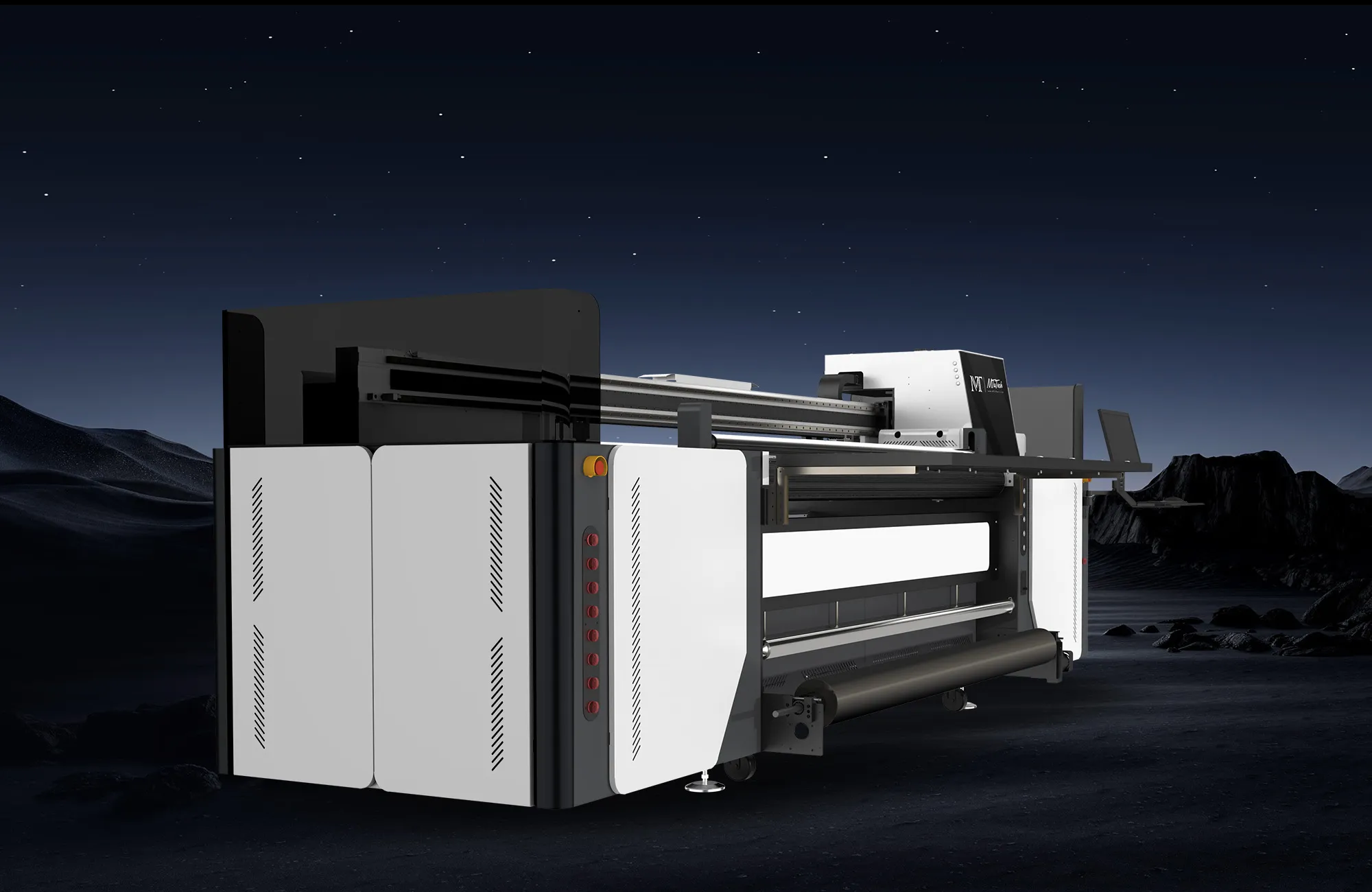
Simple Answer: Choose Based on Your Dominant Workload
If 80 percent of your work is rigid boards, sheets, panels, acrylic, glass, wood, or metal, a flatbed UV printer may be the cleaner choice. If 80 percent is banners, films, flexible media, wallcovering, or roll graphics, roll-to-roll equipment may be more efficient. If the business regularly sells both rigid display boards and flexible media, a hybrid UV printer can make sense.
| Workflow | Best for | Main caution |
|---|---|---|
| Flatbed UV printer | Rigid boards, panels, acrylic, metal, wood, glass, product samples | Less efficient for true roll-media production |
| Roll-to-roll UV printer | Flexible media, banners, films, wallcovering, roll graphics | Cannot handle rigid boards without another workflow |
| Hybrid UV printer | Shops mixing rigid boards and roll media | Needs disciplined media handling and enough volume in both categories |
What a Flatbed UV Printer Does Best
A flatbed UV printer gives the operator a stable bed for rigid materials. It is ideal for signs, panels, acrylic, glass, metal, wood, product samples, packaging boards, display pieces, and small industrial parts. The biggest advantage is control. The material sits still, the bed supports it, and the operator can use fixtures for repeat products.
Flatbed UV also supports product-specific workflows such as UV Printer 9060 jobs, visual alignment projects with visual positioning UV printer, and commercial application work from the applications page. For businesses selling rigid, premium, direct-to-object output, flatbed remains a strong center of production.
What Roll-to-Roll UV Does Best
Roll-to-roll UV printing is built for flexible media. Banners, films, backlit graphics, wallcoverings, soft signage, stickers, and flexible display products need feed control, tension, and roll handling. If flexible media is the core business, a dedicated roll workflow can be faster and simpler than forcing everything through a mixed system.
The weakness is obvious: roll-to-roll does not solve rigid boards. A signage company that also prints acrylic panels, display boards, wood, metal, and packaging samples needs another workflow for those jobs.
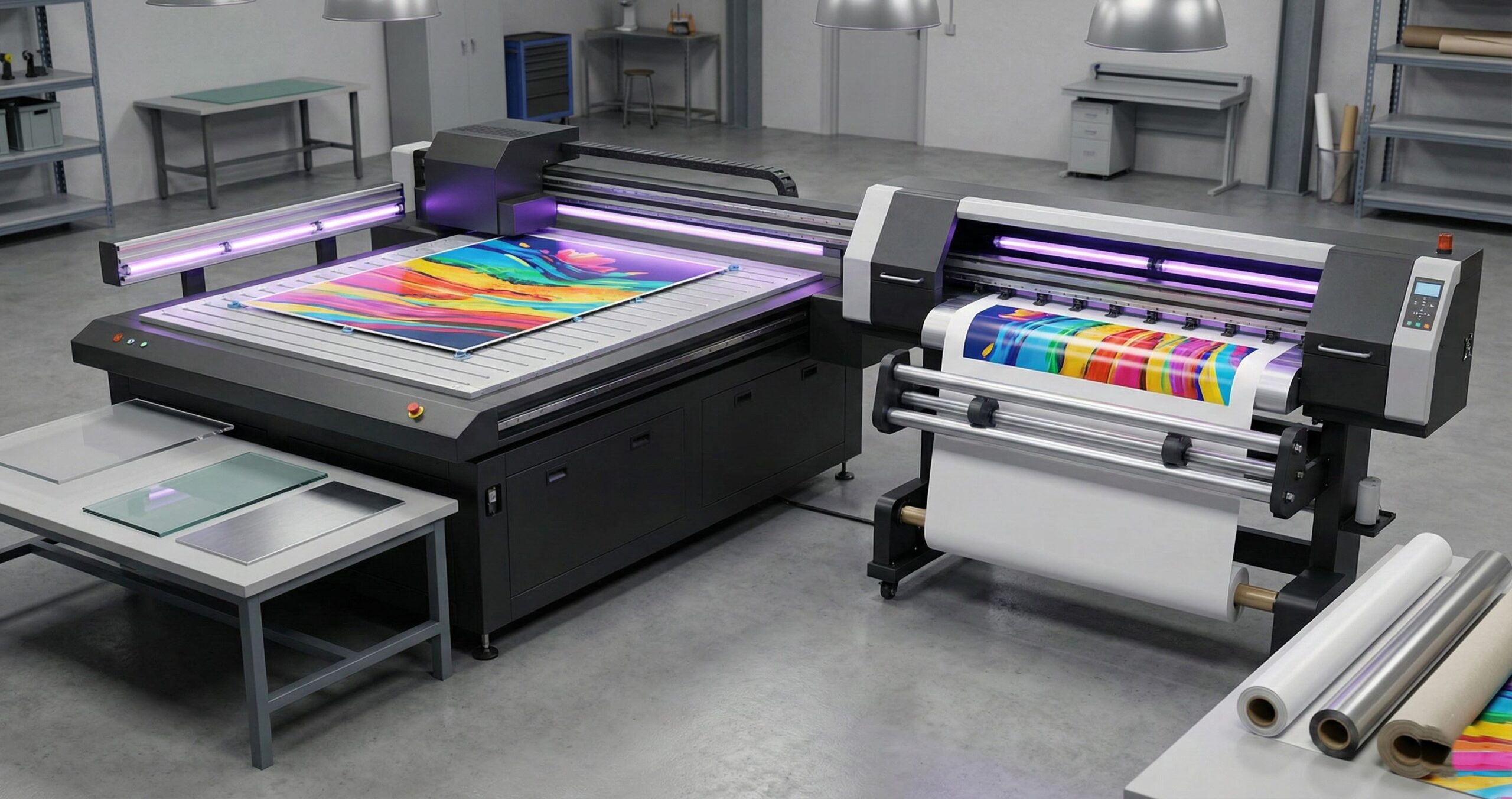
What a Hybrid UV Printer Adds
A hybrid UV printer attempts to bridge the gap. It can print on rigid boards and roll media, which makes it attractive for shops serving signage, display graphics, retail, packaging, event production, and mixed commercial clients. It can reduce the need for two separate machines when volume and workflow are balanced.
The important word is balanced. A hybrid printer should not be purchased only because it sounds versatile. It should be purchased because the business has enough rigid and roll work to justify the extra complexity, floor planning, media handling, and operator training.
Production Workflow Comparison
| Question | Flatbed UV | Roll-to-roll UV | Hybrid UV |
|---|---|---|---|
| Rigid boards? | Excellent | No | Good to excellent |
| Flexible rolls? | Limited | Excellent | Good |
| Fixture control? | Strong | Not the focus | Useful for rigid mode |
| Floor space | Depends on bed size | Roll handling space | Needs room for both modes |
| Operator skill | Material height and bed setup | Tension/feed/media setup | Both rigid and roll discipline |
| Best SEO target | UV printer | Roll-media support content | hybrid UV printer |
Use Cases Where Hybrid UV Makes Sense
- A signage shop prints rigid boards during the week and flexible banners for events.
- A display producer handles retail panels, point-of-sale boards, and roll graphics.
- A packaging prototype team needs boards, sample displays, and occasional flexible materials.
- A commercial printer wants to expand from rigid flatbed work into wider display applications.
- A production team has limited space but steady demand across both rigid and roll jobs.
Use Cases Where Flatbed UV Is Better
- The shop mostly prints rigid boards, acrylic, glass, metal, wood, and product samples.
- Repeat fixtures and exact placement are more important than roll-media speed.
- The business sells premium direct-to-object output rather than flexible graphics.
- The buyer is comparing models such as UV Printer 9060 and larger flatbed systems.
- The team wants a focused workflow that is easier to train and standardize.
Use Cases Where Roll-to-Roll Is Better
- The business is mostly banners, wallcovering, flexible signage, films, or roll graphics.
- Jobs are long-run flexible media rather than short-run rigid boards.
- Media tension, feed consistency, and finishing speed matter more than object placement.
- Rigid board jobs are rare or already handled by another machine.
Ink, Curing, and Media Handling
Hybrid UV printing adds media-handling variables. Rigid boards need height control, flatness, and alignment. Roll media needs feed stability, tension, and drying/curing consistency across longer runs. The operator must understand both. If a team is not trained, the hybrid advantage can become a troubleshooting burden.
That is why RIP software and saved production profiles matter. A hybrid workflow should have presets for rigid boards, flexible films, display media, white ink, varnish, and repeat customers. Without standard settings, every job becomes a new experiment.
Cost and ROI Considerations
A hybrid UV printer can reduce equipment count, but it is not automatically cheaper. Buyers should compare purchase cost, floor space, operator training, material handling, expected order mix, service support, and finishing requirements. If the shop only occasionally prints roll media, a hybrid may be underused. If roll and rigid work are both steady, a hybrid can be a strong production center.
ROI should be calculated by product packages. Examples include retail display kits, event signage bundles, packaging prototype sets, rigid boards plus flexible banners, and branded launch materials. A hybrid printer becomes easier to justify when sales packages use both sides of the workflow.
How This Supports Ranking and Page Ownership
This article should rank for comparison and buyer-intent terms while sending authority to the hybrid UV printer commercial page. It should also support the main UV printer page, the applications page, and the machine comparison page. That structure helps Google understand that MTuTech has both commercial product pages and supporting buyer education.
Floor Space and Media Handling
Floor space is often ignored until installation week. Flatbed printers need room for loading, unloading, material staging, and safe access around the bed. Roll-to-roll workflows need room for media rolls, take-up systems, trimming, finishing, and storage. Hybrid UV printers need planning for both. A shop that underestimates handling space may technically fit the machine but struggle to run profitable jobs.
The buyer should map the physical workflow before purchase. Where does raw material enter? Where are boards cleaned? Where does printed media cure, cool, or wait for finishing? Where are finished jobs inspected and packed? Hybrid production can be efficient, but only if the production area supports the movement of both rigid and flexible materials.
Three Realistic Workflow Examples
A rigid-display shop may use a flatbed UV printer for acrylic signs, boards, and product displays, then outsource occasional banners. In that case, a hybrid machine may be unnecessary. A retail display producer may print rigid panels, flexible graphics, and promotional launch kits every week. That business is a stronger hybrid candidate. A banner-heavy shop may focus on roll-to-roll equipment and add flatbed later only when rigid demand becomes consistent.
These examples show why the right answer changes by business model. Equipment should follow proven sales demand, not the other way around. A machine that is technically versatile but commercially underused does not help ROI.
Common Mistakes in Hybrid UV Buying
- Buying hybrid because it sounds flexible without confirming enough roll and rigid demand.
- Underestimating training needs for two different media-handling modes.
- Ignoring finishing, trimming, packing, and staging space.
- Using the same pricing method for rigid boards and flexible media.
- Failing to build profiles for different materials and print modes.
- Letting the comparison article compete with the main hybrid product page instead of supporting it.
Phase 2 SEO Role of This Article
This article is designed to close a competitor content gap. Established hybrid and industrial UV competitors often have mature category pages, comparison content, and application proof. MTuTechPrinter needs support content that explains the buyer decision in practical terms, then points readers to the hybrid UV printer page. That gives the commercial page more topical support and clearer internal anchors.
The article also gives internal-link support to UV printer, applications, machine comparison, and RIP software. This is useful because hybrid UV buyers often compare machine family, application fit, software, media handling, and ROI in one research journey.
Questions Buyers Should Ask
- What percentage of our monthly orders are rigid vs flexible?
- Do we have enough roll-media demand to justify hybrid complexity?
- Do we need white ink, varnish, or layered effects on both rigid and flexible media?
- Can our floor space support loading, unloading, roll handling, and finishing?
- Which product packages will sales sell to recover the investment?
- Who will maintain profiles, media settings, and quality checks?
Flatbed, Roll-to-Roll, and Hybrid UV: Operational Tradeoffs
The best equipment choice is often decided by operations before it is decided by print quality. A flatbed UV printer gives a stable platform for rigid sheets and shaped products. A roll-to-roll UV printer is built around feed control, tension, and flexible media handling. A hybrid UV printer combines both ideas, but that flexibility only creates value when the shop has enough rigid and flexible work to keep both modes active.
| Operational factor | Flatbed UV | Roll-to-roll UV | Hybrid UV |
|---|---|---|---|
| Material staging | Sheets, boards, fixtures, and product trays | Roll stock, take-up, trimming, and finishing | Needs both sheet staging and roll handling space |
| Operator routine | Height checks, bed cleaning, fixtures, and placement | Media loading, tension, feed accuracy, and finishing | Operator must understand both rigid and roll workflows |
| Best margin source | Rigid premium jobs, samples, displays, and panels | Flexible graphics, banners, films, and wallcovering | Mixed-client production with steady demand across both categories |
| Main risk | Limited roll-media flexibility | No rigid board capability | Underusing one side of the machine |
When Hybrid UV Is the Right Strategic Move
A hybrid UV printer can be the right move when the shop already sells rigid display boards, packaging samples, event graphics, flexible media, and retail graphics to the same client base. In that situation, hybrid production can reduce outsourcing, keep more jobs in-house, and let the sales team offer a wider application mix. The value is strongest when the buyer can point to real monthly orders, not just a general desire to be flexible.
Hybrid UV also helps when floor space and staffing make two separate production lines difficult. A shop with limited room may prefer one well-planned hybrid workflow over separate flatbed and roll equipment. However, the buyer still needs realistic loading space, media storage, finishing capacity, and operator training. A hybrid machine squeezed into a poor layout can become slower than two specialized machines in a better layout.
When a Separate Flatbed or Roll Workflow Is Smarter
If rigid boards and direct-to-object products create most of the revenue, a focused flatbed workflow may be more profitable. The shop can invest in fixtures, bed efficiency, product staging, color control, and repeatable sample approval. In that case, the buyer should compare the main UV printer page and model-specific options such as UV Printer 9060.
If flexible media is the main business, roll-to-roll production may still win. Banners, films, wallcoverings, retail graphics, and long flexible runs need feed control and finishing speed. A hybrid machine can do flexible work, but a dedicated roll workflow may be simpler when rigid work is rare. The decision should follow revenue mix, not the broadest machine description.
Buyer Checklist Before Choosing Hybrid UV
- List the last 50 sellable jobs and divide them into rigid, flexible roll, cylindrical, and transfer categories.
- Check whether rigid and roll work both appear every month, not just occasionally.
- Estimate floor space for loading, unloading, roll handling, trimming, storage, and safe operator movement.
- Compare hybrid cost against the revenue that would otherwise be outsourced.
- Review hybrid UV printer, applications, and machine comparison pages before requesting a final recommendation.
How to Build a Hybrid UV Printer Business Case
A hybrid UV printer should be justified with a business case, not only a feature comparison. The buyer should list current outsourced jobs, jobs that were rejected because the shop lacked capacity, and jobs that could be bundled for existing customers if rigid and flexible production were available in-house. If the monthly value of those opportunities is meaningful, hybrid UV becomes easier to justify. If the list is mostly speculative, a focused flatbed or roll workflow may be safer.
The business case should also include finishing, storage, and staffing. Printing is only one part of the order. Rigid boards may need trimming, packaging, handling, or installation preparation. Roll media may need cutting, lamination, mounting, or shipping. A hybrid UV printer can increase the type of work a shop accepts, but the finishing department must be ready for that variety. A buyer who ignores finishing capacity may win more jobs but struggle to deliver them profitably. The best purchase is the one the team can run repeatedly.
For SEO and sales routing, this article should not compete with the main hybrid UV printer commercial page. Its job is to educate early-stage buyers, answer comparison questions, and then move qualified readers toward model review, application examples, and consultation. That keeps the content cluster useful for search while protecting the commercial page as the primary conversion destination.
FAQ
Is a hybrid UV printer better than a flatbed UV printer?
It is better only when the shop needs both rigid and flexible media production. If rigid products dominate, a flatbed UV printer may be more focused and easier to manage.
Can a hybrid UV printer replace roll-to-roll equipment?
For some mixed shops, yes. For high-volume flexible media specialists, dedicated roll-to-roll equipment may still be more efficient.
Who should buy a hybrid UV printer?
Signage, display, packaging, and commercial print shops with steady demand across rigid boards and flexible media are the strongest candidates.
Which MTuTech page should a buyer review next?
Review the hybrid UV printer page first, then compare broader options through machine comparison or contact MTuTech for a product-mix recommendation.
Bottom line: hybrid UV is not about owning the most flexible-sounding machine. It is about matching real order mix to the right media-handling workflow. When rigid and roll demand are both real, hybrid UV can be a strong Phase 2 commercial cluster topic for MTuTechPrinter.