
UV ink peels off certain substrate materials within days without proper surface preparation for UV printing. Many printers blame their UV printer when the real problem sits on unprepared surfaces. Adhesion promoters create chemical bonds between ink and difficult materials like glass or polypropylene. Poor preparation ruins expensive jobs and damages customer relationships permanently over time.
Substrate coating for UV printing solves adhesion failures that untreated surfaces constantly cause producers. UV printing primer selection depends on material type and final product durability requirements specifically. We tested dozens of surface coating solutions before finding reliable options for each substrate category.
UV ink adhesion promoter products vary widely in performance so testing matters before production runs. UV printing coating types range from spray primers to wipe-on solutions for different workflow needs. Modern UV printers like our Hybrid UV Printer print on many materials but some surfaces require specialized coatings for durability.
Why Do Substrate Coatings Matter in UV Printing?
UV inks struggle to grip certain printing substrates with low surface energy levels naturally. UV printing adhesion fails when inks sit on smooth surfaces without proper anchoring points. Substrate surface preparation increases surface energy so inks can bond properly during production. Many valuable materials become printable only after applying the right substrate coating for UV printing.
Without coatings your material options stay limited to easy surfaces only unfortunately. Proper preparation expands what your equipment can handle profitably every single day.
Understanding Ink Adhesion in UV Printing
UV ink adhesion depends on chemical and mechanical bonds forming during the curing process. Ink bonding happens when UV light triggers polymerization that locks ink to surfaces. Smooth materials lack microscopic texture that helps mechanical adhesion grip during printing. Chemical bonds form only when surface chemistry matches ink formulation requirements properly.
We tested identical prints on treated versus untreated glass samples side by side. Untreated samples peeled within 24 hours while coated versions lasted months without damage. Surface preparation creates conditions that allow both bond types to form strongly.
Problems Caused by Poor Surface Preparation
Printing adhesion problems show up immediately or develop over days after delivery unfortunately. Peeling prints embarrass your business when products fail in customer hands publicly. Poor curing happens when ink cannot anchor properly causing soft tacky surfaces. Scratches appear easily on poorly bonded prints ruining otherwise good looking graphics quickly.
Customer returns eat into profit margins and damage your reputation with buyers directly. We rejected one supplier after their untreated acrylic caused 40% job failures consistently. Testing surface preparation before production prevents these costly problems from reaching customers.
How Coatings Improve Print Durability
Durable UV printing results require proper foundation layers beneath actual ink deposits. Protective coatings create intermediate layers that grip both substrate and ink strongly. Scratch resistance improves dramatically when ink bonds to the coating rather than bare material. Outdoor products need coating systems designed for UV exposure and weather conditions.
Indoor products benefit from coatings preventing damage from cleaning chemicals and handling. Premium products justify coating costs through better performance and fewer customer complaints. Match coating chemistry to expected product use for best long term durability results.
What Types of Substrate Coatings Are Used in UV Printing?
Picking wrong coatings wastes money and causes print failures on customer jobs repeatedly. UV printing coating types vary based on material chemistry and final product requirements. Substrate primer types include adhesion primers and clear coatings for different purposes. Each substrate coating for the UV printing category solves specific problems that printers face daily.
Matching coating type to material type prevents adhesion failures before they happen completely. Most people find success once they understand which coating works for each substrate.
Adhesion Promoter Primers
UV primer products modify surface chemistry to accept ink bonding more effectively overall. Chemical adhesion promoters create reactive sites where ink molecules can attach strongly permanently. These primers dry clear and add minimal thickness to finished product surfaces typically. Apply thin even coats to avoid drips that show through printed graphics obviously.
We spray primers in dedicated booths to prevent dust contamination ruining adhesion performance. Allow proper flash time before printing or primer effectiveness drops significantly always. Test adhesion with tape pull tests before running full production batches confidently.
Transparent Coating Layers
Clear coating layer products protect finished prints from scratches and environmental damage completely. Protective coatings apply over printed graphics sealing ink beneath tough transparent barriers safely. Gloss finishes intensify colors while matte versions reduce glare and fingerprint visibility nicely. Some coatings add UV protection preventing outdoor prints from fading over time.
Apply top coats after ink fully cures to prevent trapping solvents beneath the surface. Coating thickness affects scratch resistance so follow manufacturer recommendations for proper protection levels.
Specialty Coatings for Difficult Materials
Specialty printing primers exist specifically for materials that reject standard primer formulations completely. Glass coating products contain silane compounds that bond to silica surfaces chemically naturally. Metal primer formulations include corrosion inhibitors protecting against oxidation beneath printed graphics constantly. Polypropylene and polyethylene need flame treatment or specialty primers matching their low chemistry.
Test specialty primers on sample pieces before committing to production on expensive materials. Each difficult material requires specific coating chemistry matching its surface properties exactly always.
How to Choose the Right Primer for Different Materials
Using wrong primers creates adhesion failures that waste materials and ruin customer deadlines badly. Substrate primer selection requires matching chemistry to your specific acrylic, glass, metal, or plastic surfaces. UV printing material compatibility depends on understanding how each material reacts with different coatings. Your substrate coating for UV printing must suit the exact material sitting on your print bed.
Random primer choices lead to inconsistent results that frustrate production teams daily everywhere. Proper material analysis prevents costly trial and error on expensive customer jobs completely.
Coatings for Plastic and Acrylic Materials
Plastic surface primer products modify low energy surfaces for better ink reception immediately. Acrylic sheets accept many primers but polycarbonate needs specific formulations matching its chemistry. Cast acrylic behaves differently than extruded versions requiring adjusted primer selection carefully. Plastics with UV stabilizers sometimes reject standard primers causing unexpected adhesion problems.
We tested five primer brands on polycarbonate before finding one that worked consistently. Clean surfaces thoroughly with isopropyl alcohol before applying any plastic primer coating. Allow full drying time or trapped solvents that cause bubbling beneath printed graphics.
Primers for Glass and Ceramic Surfaces
MTuTech production notes for UV printer ink
For buyers comparing UV printer ink options, the strongest ranking signal is not only the definition of the process. The page should also explain machine fit, production limits, material behavior, ink or fixture requirements, and the next page a buyer should read before requesting a quote.
Best machine fit
Use this guide together with UV Printer when the job requires stable UV output, repeatable setup, and production-ready print quality. If the work involves different shapes, materials, or order sizes, compare it with UV DTF Printer before choosing the final printer.
Production checklist
- Confirm the printable area, part height, and fixture or rotary requirements before quoting the job.
- Match ink, primer, and curing settings to the substrate so adhesion and scratch resistance are predictable.
- Standardize artwork preparation, white ink layers, and test prints before moving into batch production.
- Track production cost by ink use, setup time, rejects, and finishing steps instead of looking only at printer price.
Related MTuTech resources
FAQ
Which MTuTech printer should this article connect to? The best next page depends on the material, shape, and production volume. Flat products usually start with UV printer or UV Printer 9060 pages, while bottles, tumblers, and round products should connect to rotary, cylinder, tumbler, or cylindrical printer pages.
What should buyers check before ordering? Buyers should confirm print size, material compatibility, white ink needs, fixture design, curing performance, maintenance expectations, and whether the workflow supports repeatable production rather than one-off samples only.
Glass printing primer contains silane coupling agents that bond chemically to silica surfaces. Glass panels need thorough cleaning to remove oils and manufacturing residues completely first. Ceramic tiles with glazed surfaces act like glass requiring similar primer approaches typically. Porous unglazed ceramics absorb primers differently, needing adjusted application quantities carefully always.
Surface cleanliness matters more on glass than almost any other material type. Fingerprints invisible to eyes cause adhesion failures in those exact spots unfortunately.
Metal Surface Coatings for UV Printing
Metal printing primer formulations include corrosion inhibitors protecting printed surfaces long term effectively. Aluminum accepts primers easily but requires degreasing before application for proper bonding. Stainless steel needs specialized primers matching its chromium oxide surface layer chemistry specifically. Powder coated metals print directly without primers but raw metals always need preparation.
Oxidation layers on metals interfere with primer adhesion if not addressed beforehand properly. Light abrasion improves mechanical bonding on smooth polished metal surfaces significantly.
How to Prepare Surfaces Before Applying Coating
Dirty substrates reject coatings that otherwise work perfectly on clean material surfaces. Surface preparation for UV printing removes invisible contaminants blocking proper primer adhesion completely. Substrate cleaning with proper cleaning solutions creates surfaces ready to accept coatings properly. Even surface sanding helps on certain materials that need a mechanical texture for bonding.
Skipping preparation steps ruins substrate coating for UV printing effectiveness on any material type. Most adhesion failures trace back to contamination missed during surface preparation stages.
Cleaning the Substrate Surface
Your substrate cleaning process must remove oils and dust before any coating application begins. Alcohol wipes work well for general cleaning on most plastic and metal surfaces. Cleaning solvents like acetone tackle stubborn manufacturing residues that alcohol cannot remove. Lint-free cloths prevent fiber contamination that shows through finished printed graphics badly.
We use two-step cleaning with solvent first then alcohol as a final wipe consistently. Allow surfaces to dry completely before coating, or trapped moisture causes adhesion problems. Wear gloves after cleaning to prevent finger oils from recontaminating prepared surfaces accidentally.
Applying Coatings and Primers Correctly
Primer application methods affect how evenly the coating is distributed across the substrate surfaces completely. Spray coating delivers thin uniform layers that dry quickly without brush marks showing through. Brush coating works for small areas but risks uneven thickness, causing print quality variations. Maintain a consistent distance during spraying to prevent heavy spots and thin areas.
Multiple thin coats outperform single thick applications for adhesion strength every time. Cross-hatch spray patterns ensure full coverage without building up excessive coating thickness anywhere.
Understanding Drying and Curing Times
Coating drying time varies based on temperature and humidity in your workspace significantly. The drying process removes carrier solvents before printing can begin safely on treated surfaces. Print too early and trapped solvents cause bubbling beneath UV ink layers later. Wait too long and coating surface chemistry changes, reducing ink adhesion slightly.
Most primers need 10 to 30 minutes drying depending on environmental conditions present. Touch test edges to verify dryness before loading coated substrates for actual printing jobs.
How Hybrid UV Printers Handle Multiple Materials
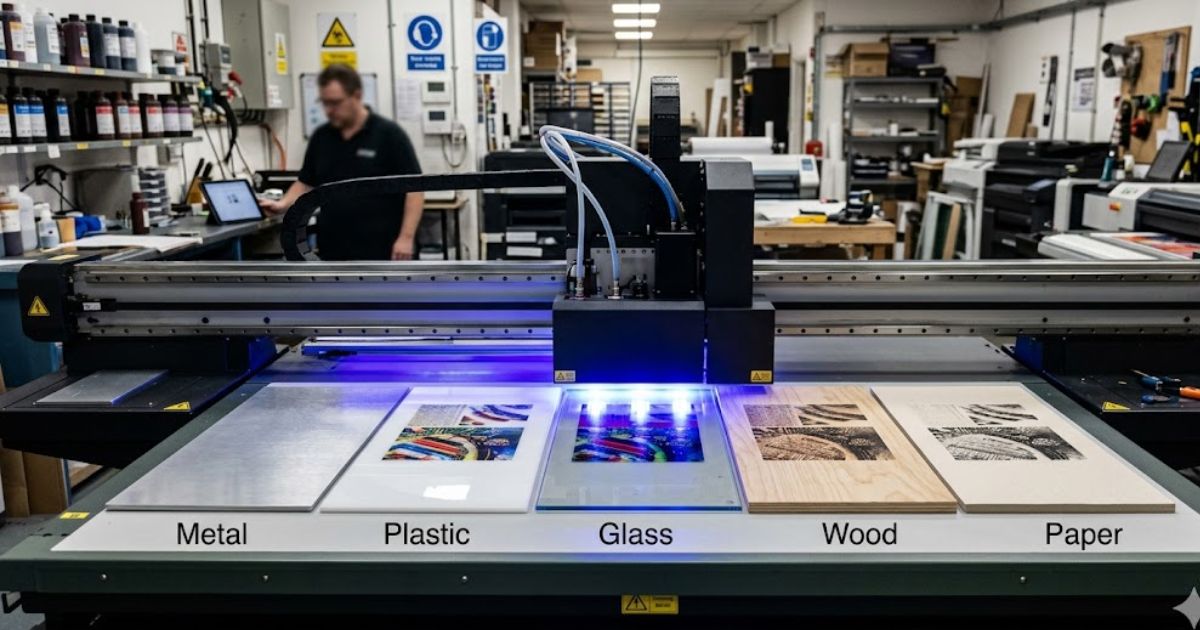
Standard printers limit you to specific printing materials causing lost revenue on diverse orders. Hybrid UV printing technology accepts rigid and flexible substrates on the same flatbed printing system. Multi-material UV printers switch between material types without major setup changes between jobs. Your substrate coating for UV printing choices expand dramatically with versatile equipment capabilities.
For large format work on multiple substrates, machines like the Flatbed UV Printer 2513 handle everything from acrylic sheets to vinyl rolls in a single shift. We run glass panels then switch to fabric banners using proper coating on each substrate. Match coating supplier recommendations to your specific machine and material combinations for best results.
FAQS
Why do some materials require a primer in UV printing?
Low surface energy materials repel UV inks without chemical modification through proper coating. UV printing primer selection creates bonds where inks naturally refuse to stick properly.
What substrates need coating before UV printing?
Glass and polypropylene require substrate coating for UV printing almost always for adhesion. Metals and certain plastics also benefit from primer application before production runs.
How do adhesion promoters work in UV printing?
Promoters chemically modify surface energy allowing UV inks to bond during curing cycles. Chemical reactions create anchor points where ink molecules attach permanently to substrates.
How long should primers dry before printing?
Most primers need 10 to 30 minutes depending on room temperature and humidity levels. Touch test edges to confirm dryness before loading substrates for actual printing.
Can UV printers print without substrate coating?
Yes, on high energy materials like paper and wood that naturally accept UV inks. Low energy materials fail without proper coating causing peeling and adhesion problems.
Explore Compatible Materials Today
Ready to print on diverse substrates with professional quality results every single time now? Explore our UV printer collection at MTuTech Printers designed for multi-material production and advanced applications. Professional solutions handle coated and uncoated materials with consistent quality output daily.
Commercial Buyer Notes for substrate coating for UV printing
This topic matters because operators selecting primers and coatings for better UV ink adhesion. A post can rank for an informational keyword and still support a commercial page when it answers the practical questions a buyer asks before requesting a quote. For MTuTechPrinter.com, this article should guide readers toward the right production path instead of competing with the main product page.
The best audience for this page is production teams printing on glass, metal, plastic, acrylic, and coated substrates. These visitors are usually not looking for a basic definition only. They want to know whether the workflow fits their products, whether the machine can handle the job repeatedly, and what problems they should avoid before investing in equipment.
Best-fit buyer scenarios
- Low-surface-energy plastics where buyers care about repeatability, realistic cost per job, and a production process that does not collapse once order volume increases.
- Glass and metal panels where buyers care about repeatability, realistic cost per job, and a production process that does not collapse once order volume increases.
- Coated packaging where buyers care about repeatability, realistic cost per job, and a production process that does not collapse once order volume increases.
- Outdoor handled items where buyers care about repeatability, realistic cost per job, and a production process that does not collapse once order volume increases.
Production checks before choosing a printer
- Cross-hatch test should be tested on the same materials, blanks, inks, and finishing conditions the shop will use for paid orders.
- Cure compatibility should be tested on the same materials, blanks, inks, and finishing conditions the shop will use for paid orders.
- Primer drying time should be tested on the same materials, blanks, inks, and finishing conditions the shop will use for paid orders.
- Batch consistency should be tested on the same materials, blanks, inks, and finishing conditions the shop will use for paid orders.
How This Article Supports the Main Product Pages
The primary commercial path from this article should lead to UV printer. Readers who are comparing related workflows can also review UV DTF printer, hybrid UV printer. This keeps the blog post useful as an educational asset while passing topical relevance to the commercial pages that should rank for buyer-intent terms.
For search engines, this creates a cleaner hierarchy: the blog post handles long-tail questions, application details, mistakes, workflow checks, and comparison language; the product page remains the main destination for machine specifications, inquiry intent, and conversion. That structure helps reduce keyword overlap and gives Google clearer signals about which page should own the commercial keyword.
Internal linking recommendation
When this article is referenced from future content, use natural anchors such as “substrate coating for UV printing”, “commercial substrate coating for UV printing workflow”, and “buyer guide for substrate coating for UV printing”. Reserve exact commercial anchors for the product page, especially when building external guest posts or high-authority references.
Decision Table for Commercial Use
| Use case | Key check | Why it matters |
|---|---|---|
| low-surface-energy plastics | cross-hatch test | Use this as a buying signal before choosing the final printer workflow. |
| glass and metal panels | cure compatibility | Use this as a buying signal before choosing the final printer workflow. |
| coated packaging | primer drying time | Use this as a buying signal before choosing the final printer workflow. |
| outdoor handled items | batch consistency | Use this as a buying signal before choosing the final printer workflow. |
What Makes This Topic Easier to Rank
The easiest ranking angle is not to repeat broad product-page copy. The stronger approach is to answer specific buyer questions around setup, mistakes, material fit, cost control, workflow, and production risk. Those long-tail topics usually create impressions earlier than broad head terms, especially in the United States where buyers compare several suppliers before contacting a manufacturer.
This article should therefore be used as a support asset: keep the language practical, connect it to real production decisions, and link clearly to the right MTuTech Printer page. Over time, impressions from these long-tail phrases can help the site build topical authority and send more qualified visitors toward the pages that matter commercially.