
Best Tumbler Printer: UV vs Sublimation Comparison
Complete 2026 Guide to Choosing the Right Tumbler Printing Technology for Your Business
| Quick Answer: UV tumbler printers are better for most businesses due to their material versatility, faster production speeds, and ability to print on any tumbler material (stainless steel, glass, plastic) without special coatings. Sublimation is more affordable to start but limited to polymer-coated tumblers only. For a serious drinkware business, UV printing offers higher profit potential and fewer material restrictions. |
Introduction: UV vs Sublimation for Tumbler Printing
If you’re looking to start a custom tumbler business or expand your print shop into drinkware, you’ve likely encountered two main printing technologies: UV printing and sublimation printing. Both can produce beautiful, durable designs on tumblers, but they work very differently and are suited for different business models.
This comprehensive comparison will help you understand the key differences between UV tumbler printers and sublimation tumbler printers, including print quality, material compatibility, production speed, costs, and which technology is best suited for your specific needs.
How Each Technology Works
UV Tumbler Printing
UV printing uses ultraviolet light to instantly cure (dry) specially formulated UV inks directly onto the tumbler surface. A tumbler printer with rotary attachment rotates the tumbler while the printhead moves across, applying ink that is immediately hardened by UV LED lamps.
The process: Design → Print directly onto tumbler → UV light cures ink instantly → Ready to use immediately
Sublimation Tumbler Printing
Sublimation is a heat-transfer process where special dye-sublimation ink is printed onto transfer paper, then heat-pressed onto the tumbler. Under heat (360-400°F) and pressure, the ink converts to gas and permanently bonds with the polymer coating on the tumbler surface.
The process: Design → Print on transfer paper → Wrap paper around tumbler → Heat press (3-5 minutes) → Remove paper → Done
UV vs Sublimation: Side-by-Side Comparison
| Factor | UV Tumbler Printer | Sublimation Printer |
| Material Compatibility | ANY material — stainless steel, glass, plastic, ceramic, aluminum | Polymer-coated surfaces ONLY |
| Print Speed | 30-90 seconds per tumbler | 3-5 minutes per tumbler (plus cooling) |
| Startup Cost | $3,000-$20,000+ | $500-$2,000 (printer + press) |
| Cost Per Print | $0.50-$2.00 | $0.30-$1.00 (ink + paper) |
| Print on Dark Colors | YES — with white ink layer | NO — white/light colors only |
| Color Vibrancy | Excellent — sharp, defined edges | Excellent — vibrant, smooth blending |
| Durability | Excellent — scratch/fade resistant | Good — ink infuses into coating |
| Dishwasher Safe | Yes (with proper pretreatment) | Yes (top rack recommended) |
| Texture Effects | YES — raised 3D, gloss, matte | NO — flat prints only |
| Learning Curve | Moderate — 1-2 weeks | Easy — beginner-friendly |
| Best For | Business growth, high volume, versatility | Hobbyists, low budget, fabric focus |
UV Tumbler Printer: Pros & Cons
Advantages of UV Tumbler Printing
- Print on ANY material: Stainless steel, glass, ceramic, plastic, aluminum — no special coatings required
- Print on dark colors: White ink capability allows vibrant prints on black, navy, or colored tumblers
- Instant production: UV curing means tumblers are ready immediately — no waiting for heat press cycles
- Faster throughput: 30-90 seconds per tumbler vs 3-5+ minutes for sublimation
- Special effects: Raised textures, gloss/matte finishes, 3D tactile effects with varnish layer
- Superior scratch resistance: UV-cured inks are extremely durable
- Direct printing: No transfer paper, no wrapping, no alignment issues
- Scalable for business: Higher volume production with lower labor per item
Disadvantages of UV Tumbler Printing
- Higher startup cost: Entry-level UV tumbler printers start around $3,000-$6,000
- White ink maintenance: Requires daily circulation to prevent settling and clogging
- Learning curve: More technical setup compared to sublimation
- Print sits on surface: Unlike sublimation where ink infuses into material, UV ink cures on top (though highly durable)
Sublimation Tumbler Printer: Pros & Cons
Advantages of Sublimation Tumbler Printing
- Lower startup cost: Complete setup (printer + heat press) under $1,500-$2,000
- Vibrant colors: Excellent color reproduction with smooth gradients
- Ink infuses into surface: Creates smooth, seamless feel — no texture on surface
- Beginner-friendly: Easier to learn, fewer technical variables
- Low maintenance: No white ink to worry about, simpler printer maintenance
- Eco-friendly inks: Water-based sublimation inks are environmentally friendly
Disadvantages of Sublimation Tumbler Printing
- Material limitation: ONLY works on polymer-coated or polyester surfaces — cannot print on raw stainless steel, glass, or uncoated plastic
- No dark colors: Only works on white or light-colored tumblers
- Slower production: 3-5 minutes per tumbler plus cooling time
- Heat press required: Additional equipment ($200-$500) and workspace needed
- Transfer paper waste: Each print requires transfer paper (ongoing cost)
- Alignment challenges: Wrapping paper around tumbler can cause registration issues
- No texture effects: Cannot create raised or 3D designs
Cost Comparison: UV vs Sublimatio
MTuTech production notes for cylinder UV printer
For buyers comparing cylinder UV printer options, the strongest ranking signal is not only the definition of the process. The page should also explain machine fit, production limits, material behavior, ink or fixture requirements, and the next page a buyer should read before requesting a quote.
Best machine fit
Use this guide together with Cylinder UV Printer when the job requires stable UV output, repeatable setup, and production-ready print quality. If the work involves different shapes, materials, or order sizes, compare it with 360 Rotary UV Printer before choosing the final printer.
Production checklist
- Confirm the printable area, part height, and fixture or rotary requirements before quoting the job.
- Match ink, primer, and curing settings to the subs
 Best Tumbler Printer: UV vs Sublimation for Drinkware Businesses production reference image for printer selection, workflow planning, and application fit.trate so adhesion and scratch resistance are predictable.
- Standardize artwork preparation, white ink layers, and test prints before moving into batch production.
- Track production cost by ink use, setup time, rejects, and finishing steps instead of looking only at printer price.
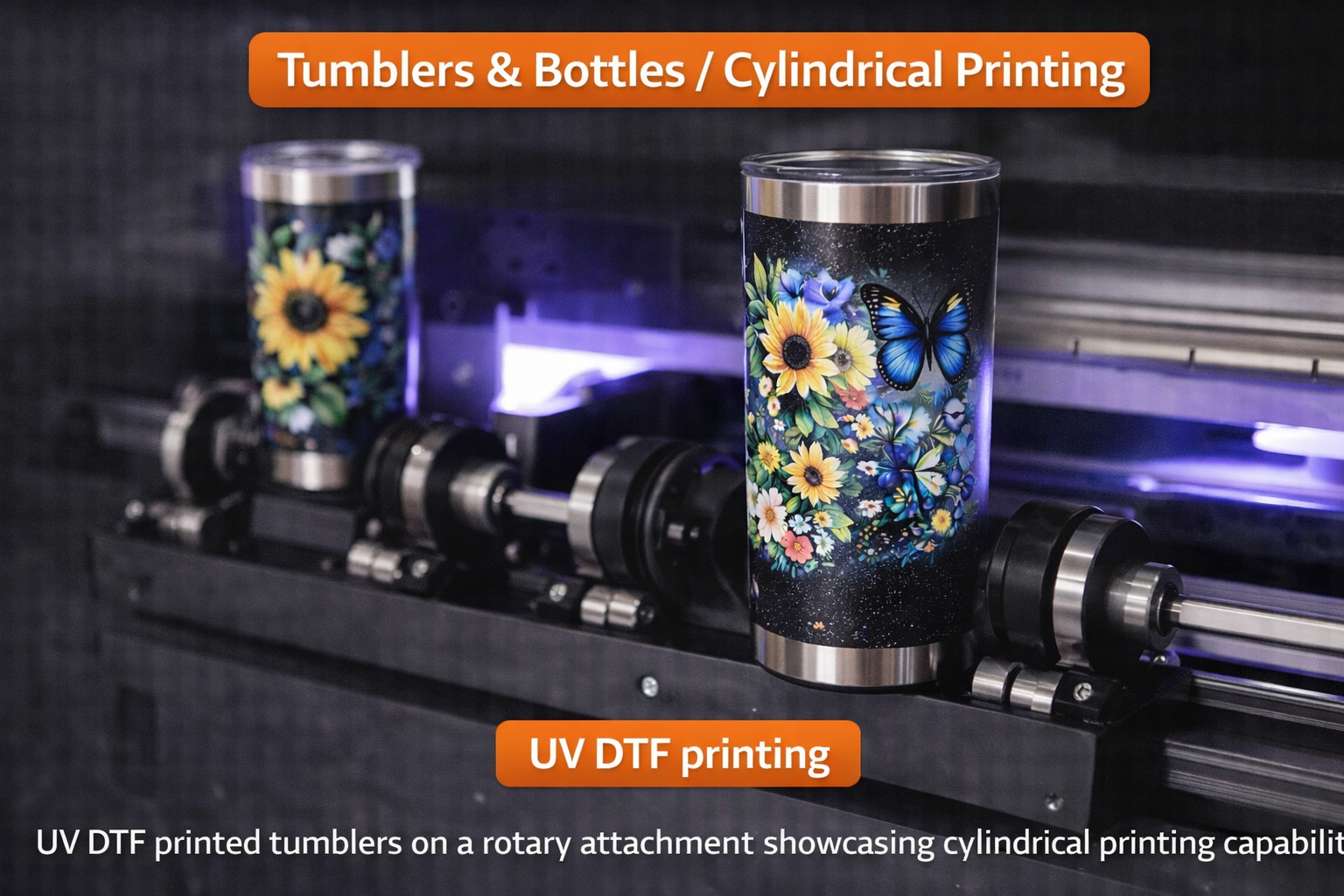 Best Tumbler Printer: UV vs Sublimation for Drinkware Businesses production reference image for printer selection, workflow planning, and application fit.trate so adhesion and scratch resistance are predictable.
Related MTuTech resources
FAQ
Which MTuTech printer should this article connect to? The best next page depends on the material, shape, and production volume. Flat products usually start with UV printer or UV Printer 9060 pages, while bottles, tumblers, and round products should connect to rotary, cylinder, tumbler, or cylindrical printer pages.
What should buyers check before ordering? Buyers should confirm print size, material compatibility, white ink needs, fixture design, curing performance, maintenance expectations, and whether the workflow supports repeatable production rather than one-off samples only.n
| Cost Category | UV Tumbler Printer | Sublimation Setup |
| Entry-Level Printer | $3,000-$6,000 | $300-$700 |
| Professional Printer | $8,000-$20,000 | $1,000-$2,000 |
| Heat Press (tumbler) | Not required | $200-$500 |
| Ink Cost (per tumbler) | $0.30-$1.50 | $0.15-$0.50 |
| Transfer Paper | $0 (direct print) | $0.20-$0.50/sheet |
| Blank Tumbler (coated) | Not required | $5-$12 each |
| Blank Tumbler (uncoated) | $3-$8 each | Cannot use |
| Total Cost Per Tumbler | $3.50-$10 | $5.50-$13 |
Key insight: While sublimation has lower startup costs, UV printing often has lower per-unit costs due to cheaper uncoated blanks and no transfer paper. At higher volumes, UV printing becomes more economical.
Which Tumbler Printer Should You Choose?
Choose UV Tumbler Printing If:
- You want to print on ANY tumbler material (stainless steel, glass, plastic)
- You need to print on dark or colored tumblers
- Speed and production volume are priorities
- You want to offer premium features like textured or 3D effects
- You’re building a serious drinkware business
- You want to expand into other products (phone cases, awards, promotional items)
Choose Sublimation Tumbler Printing If:
- You have a limited budget under $2,000
- You’re a hobbyist or making tumblers as a side project
- You only need white/light colored tumblers
- You’re already doing sublimation for apparel/fabrics
- You prefer the smooth, infused ink feel
- Low volume production (under 20 tumblers/day)
Frequently Asked Questions
Q: Which produces better quality prints — UV or sublimation?
A: Both produce excellent quality. Sublimation excels at smooth color gradients and photographic images. UV printing produces sharper edges and allows for textured effects. For most commercial applications, quality is comparable.
Q: Can I print full wraps with UV printing?
A: Yes! UV tumbler printers with 360-degree rotary attachments can print full wraparound designs seamlessly, just like sublimation.
Q: Are UV printed tumblers dishwasher safe?
A: Yes, with proper surface pretreatment and curing, UV prints are dishwasher safe and can withstand hundreds of wash cycles.
Q: Can I use a regular inkjet printer for sublimation?
A: Some inkjet printers can be converted to sublimation with special inks, but it’s recommended to use a dedicated sublimation printer for best results and to avoid ink system contamination.
Q: How long do UV tumbler prints last?
A: UV prints are highly durable and resistant to fading, scratching, and water. With proper application, prints can last years of regular use.
Q: What’s the ROI difference between UV and sublimation?
A: UV printers have higher upfront costs but often faster ROI due to higher production speeds, lower per-unit costs at scale, and the ability to print on more materials (expanding product offerings). Sublimation has lower startup costs but may limit growth.
Conclusion: The Verdict
For most businesses serious about custom drinkware, UV tumbler printing is the better long-term investment. The ability to print on any material, produce faster, and offer unique effects like raised textures provides significant competitive advantages.
However, sublimation remains an excellent choice for hobbyists, beginners, or those with very limited budgets. It’s a proven technology with beautiful results — just with more material limitations.
The best choice ultimately depends on your budget, production volume, material requirements, and business goals. Many successful print shops actually use both technologies to serve different customer needs.
Ready to explore tumbler printing? Visit our Tumbler Printer page to see our UV tumbler printing solutions, or check out our 360 Rotary UV Printer and Cylindrical Printer collections for professional drinkware printing
Related MTuTech tumbler printing pages
Use this comparison as the buying guide, then move to the correct commercial printer page based on the drinkware work you want to sell. This internal path helps buyers and search engines separate broad comparison intent from high-intent machine evaluation.
UV DTF Printer for transfer stickers, decals, and hard-surface decoration jobs.
Tumbler Printer for drinkware-focused UV printing businesses.
360 Rotary UV Printer for full-wrap bottle, cup, can, and cylinder production.
Cylindrical Printer for compact round-product printing and startup workflows.
Commercial Buyer Notes for best tumbler printer
This topic matters because drinkware sellers comparing UV, UV DTF, sublimation, and rotary printing workflows. A post can rank for an informational keyword and still support a commercial page when it answers the practical questions a buyer asks before requesting a quote. For MTuTechPrinter.com, this article should guide readers toward the right production path instead of competing with the main product page.
The best audience for this page is custom tumbler startups, established gift sellers, and B2B promotional drinkware providers. These visitors are usually not looking for a basic definition only. They want to know whether the workflow fits their products, whether the machine can handle the job repeatedly, and what problems they should avoid before investing in equipment.
Best-fit buyer scenarios
- Full-color tumbler personalization where buyers care about repeatability, realistic cost per job, and a production process that does not collapse once order volume increases.
- Corporate logo drinkware where buyers care about repeatability, realistic cost per job, and a production process that does not collapse once order volume increases.
- Small-batch ecommerce orders where buyers care about repeatability, realistic cost per job, and a production process that does not collapse once order volume increases.
- Sample and proof production where buyers care about repeatability, realistic cost per job, and a production process that does not collapse once order volume increases.
Production checks before choosing a printer
- Blank coating should be tested on the same materials, blanks, inks, and finishing conditions the shop will use for paid orders.
- Rotation accuracy should be tested on the same materials, blanks, inks, and finishing conditions the shop will use for paid orders.
- Ink durability should be tested on the same materials, blanks, inks, and finishing conditions the shop will use for paid orders.
- Speed per tumbler should be tested on the same materials, blanks, inks, and finishing conditions the shop will use for paid orders.
- Operator learning curve should be tested on the same materials, blanks, inks, and finishing conditions the shop will use for paid orders.
How This Article Supports the Main Product Pages
The primary commercial path from this article should lead to tumbler printer. Readers who are comparing related workflows can also review 360 rotary UV printer, UV DTF printer, cylinder UV printer. This keeps the blog post useful as an educational asset while passing topical relevance to the commercial pages that should rank for buyer-intent terms.
For search engines, this creates a cleaner hierarchy: the blog post handles long-tail questions, application details, mistakes, workflow checks, and comparison language; the product page remains the main destination for machine specifications, inquiry intent, and conversion. That structure helps reduce keyword overlap and gives Google clearer signals about which page should own the commercial keyword.
Internal linking recommendation
When this article is referenced from future content, use natural anchors such as “best tumbler printer”, “commercial best tumbler printer workflow”, and “buyer guide for best tumbler printer”. Reserve exact commercial anchors for the product page, especially when building external guest posts or high-authority references.
Decision Table for Commercial Use
| Use case | Key check | Why it matters |
|---|---|---|
| full-color tumbler personalization | blank coating | Use this as a buying signal before choosing the final printer workflow. |
| corporate logo drinkware | rotation accuracy | Use this as a buying signal before choosing the final printer workflow. |
| small-batch ecommerce orders | ink durability | Use this as a buying signal before choosing the final printer workflow. |
| sample and proof production | speed per tumbler | Use this as a buying signal before choosing the final printer workflow. |
What Makes This Topic Easier to Rank
The easiest ranking angle is not to repeat broad product-page copy. The stronger approach is to answer specific buyer questions around setup, mistakes, material fit, cost control, workflow, and production risk. Those long-tail topics usually create impressions earlier than broad head terms, especially in the United States where buyers compare several suppliers before contacting a manufacturer.
This article should therefore be used as a support asset: keep the language practical, connect it to real production decisions, and link clearly to the right MTuTech Printer page. Over time, impressions from these long-tail phrases can help the site build topical authority and send more qualified visitors toward the pages that matter commercially.
Common Mistakes That Reduce ROI
One common mistake is judging a machine only by the sample print shown in a demo. A sample proves the printer can produce an attractive result once. A business needs repeatability across many jobs, blanks, operators, and customer artwork files. For best tumbler printer, that means the buyer should test the workflow under realistic shop conditions before assuming the same result will hold at production volume.
A second mistake is ignoring finishing, handling, and packaging. Many print problems appear after the print leaves the bed or fixture: scratches during packing, poor adhesion after cleaning, alignment drift across repeated items, or color mismatch when the same job is repeated later. These are not only technical issues; they affect refunds, customer satisfaction, and the confidence needed to sell higher-value jobs.
The final mistake is buying without a clear product plan. A printer is easier to profit from when the shop already knows the first 5 to 10 products it wants to sell. That product list should determine bed size, rotary needs, white ink use, fixture strategy, software workflow, and the kind of support expected from the supplier.
Simple pre-purchase checklist
- Choose three real products and test best tumbler printer on each one before scaling.
- Compare setup time, print time, curing quality, and post-print handling.
- Check whether the machine supports the exact material size and shape the business will sell.
- Confirm training, maintenance, spare parts, and workflow support before purchase.
- Keep one commercial page as the main quote path and use support articles to answer detailed questions.