
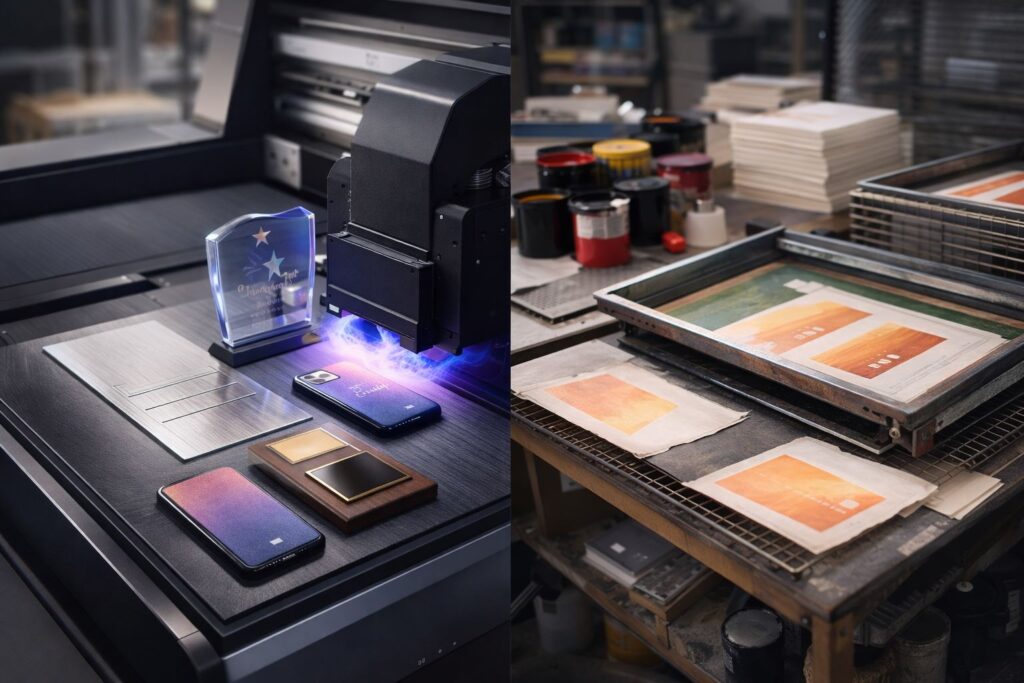
Choosing between UV and traditional printing isn’t about fancy tech specs. It’s about protecting your margins and scaling without breaking your bank. We’ve worked with dozens of online stores that burned through budgets testing both methods. The real question isn’t which prints prettier, it’s which one survives your business printing needs without killing production efficiency. Most owners panic when customization demand spikes because their old setup can’t keep up. Wrong choice here means watching turnaround time balloon while competitors ship faster.
Print durability matters when returns eat your profit, but operational cost decides if you stay open next year. Material compatibility sounds boring until you need to print on metal today and wood tomorrow. We recommend mapping your growth plan first before picking machines. Traditional methods work fine for bulk orders with zero variation. UV wins when every order needs different designs or strange surfaces. Check your scalability needs and risk tolerance, not just price tags.
How Does UV Printing Work Compared to Traditional Printing?
UV Ink Curing Changes Production Speed
UV ink hardens the second LED UV lamps hit it, no waiting around. Ultraviolet curing triggers instant polymerization that locks color onto any surface in seconds. We’ve tested this on metal and plastic with zero smudging or touch delays. Surface bonding happens during the print job, not after it finishes. Your team can stack, pack, and ship orders without babysitting drying racks. This continuous workflow cuts labor costs because nobody’s checking if prints are dry enough.
Traditional Ink Drying Affects Output Quality
Solvent based ink and water based ink both need ink absorption time before handling. Air drying takes hours while heat drying speeds things up but risks warping thin materials. We’ve seen ink bleed ruin sharp text when substrate pulls too much moisture in. Smudging happens when rushed orders get touched too early, wasting both product and time. Finish inconsistency shows up because humidity changes how fast things dry each day. Each batch acts different, making quality control a guessing game for your crew.
UV Printing vs Screen Printing Key Operational Differences
Compare Setup Time and Batch Efficiency
Screen printing demands stencil setup and mesh screens built fresh for every design change. Setup complexity eats hours before your first print even starts rolling out. We’ve watched shops lose entire mornings on prepress requirements while UV machines print immediately. Job changeover means tearing down old screens and building new ones for each client. Batch dependency locks you into printing hundreds of the same thing to justify that prep work. Downtime between jobs kills your calendar when custom orders need fast turnarounds with no waste.
Compare Surface Compatibility and Ink Adhesion
Ink layers from screens sit thick but need flat surfaces like cotton or paper. UV handles plastic, glass, metal, acrylic, and wood without special prep or primers. We’ve printed phone cases and wine bottles back to back with zero coating requirements. Adhesion strength stays strong because UV bonds chemically instead of just sitting on top. Production batch size doesn’t matter when every surface type works without switching equipment or losing time.
UV Printing vs Traditional Printing Methods Side by Side Comparison Table
| Factor | UV Printing | Screen Printing | Offset Printing |
| Setup time | Minutes | Hours | Days |
| Customization | High | Low | Very low |
| Ideal volume | Low medium | Medium | High |
| Material range | Wide | Limited | Paper based |
Which Printing Method Is Best for Your Business Type?
E-commerce and On Demand Products
Print on demand stores need flexibility because every order volume changes daily without warning. Your business model dies if you stock 500 mugs that never sell. We’ve helped shops switch to UV for personalized products where each item gets unique text or images. SKU variation becomes free when you’re not building screens for every design tweak. Low inventory risk means printing what sold today, not guessing what might sell next month. Fast fulfillment happens because machines start printing seconds after orders drop in.
Promotional and Signage Businesses
Signage and promotional products live outside where rain and sun destroy weak prints fast. Durability directly controls how long your client’s brand stays visible on their storefront. We’ve tracked display graphics that faded in weeks versus UV prints lasting years outdoors. Outdoor resistance matters because replacing banners every season kills your profit margin and annoys customers. Production strategy should match how long clients expect their message to stay sharp and bright. Scalability grows easier when you’re not redoing failed jobs or handling angry callback requests.
High Volume Commercial Printers
Commercial printing for bulk orders and publishing still favors traditional methods when designs stay identical. Cost efficiency wins when printing 10,000 identical brochures because setup time spreads thin across volume. We recommend traditional presses for repeatability jobs where every piece looks exactly like the last. Business model comparison shows UV costs more per unit on massive runs with zero customization needs.
Discover : how industrial UV printers are transforming manufacturing
Cost Analysis UV Printing vs Traditional Printing
Equipment cost looks scary upfront but hides the real money drain over three years. UV machines cost more to buy, but operating cost drops because you skip drying time and wasted materials. We’ve tracked shops where labor cost fell by half once employees stopped babysitting print jobs. Traditional setups need constant screen replacements and cleanup chemicals that add up fast every month. Maintenance frequency stays lower with UV because fewer moving parts mean fewer breakdowns and service calls. Your ROI timeline shortens when you calculate saved wages, faster output, and zero remake costs from smudged prints.
Most owners focus on sticker price and miss where money actually disappears long term. Calculate what you spend monthly on staff standing around, rejected prints, and rush shipping delays. We recommend tracking total ownership expenses across 24 months, not just comparing machine prices today. UV wins when you need variety and speed, traditional wins only for massive identical runs.
Production Speed and Customization Capabilities Compared
Turnaround Time for Short Runs
Short run printing becomes your competitive weapon when customers need orders shipped tomorrow, not next week. Job switching takes minutes with UV instead of hours tearing down screens and mixing new inks. We’ve watched clients steal contracts from competitors who couldn’t deliver custom batches in 48 hours. Turnaround time shrinks because workflow automation lets you queue different designs without manual resets between jobs. Same-day shipping becomes possible when printing finishes ready to pack without waiting for anything to dry.
Variable Data and Personalization Limits
Variable data printing turns every item into a unique product without slowing your line down. We’ve seen shops double revenue by offering custom graphics that traditional methods can’t handle economically. Design flexibility means printing 100 different phone cases in one run without stopping to change anything. Per-item uniqueness becomes your selling point instead of a production nightmare that costs you speed.
Why Choose UV Printing Over Traditional Printing?
A UV printer from Mtutech Printer eliminates the guessing game around what materials you can print on today. LED UV ink sticks permanently to rigid substrates like metal signs and glass awards without primers or coatings. We’ve tested hundreds of surfaces and watched traditional methods fail where UV succeeded every time. Versatility means accepting weird custom orders that competitors turn down because their equipment can’t handle it. Durability keeps your prints looking sharp outdoors for years instead of fading after one summer season.
Efficiency jumps because orders ship the same day without waiting for anything to cure or dry. Print 10 wedding invitations or 1,000 bottle labels without changing your workflow or losing speed between jobs. We recommend UV when your revenue depends on saying yes to unusual requests and delivering fast. Traditional printing still works fine if you’re printing identical items on paper all day long.
FAQs
Is UV printing more expensive than traditional printing?
UV printing costs a bit more upfront. But we save you money long term. No drying time means faster production. We finish jobs quicker. You get better value overall.
Does UV printing last longer outdoors?
Yes. Our UV prints resist fading and weather damage. They last 3 to 5 years outside. We use special UV cured inks. They bond stronger to surfaces.
Can UV printing replace screen printing completely?
Not always. We recommend UV printing for small batches. Screen printing works better for large orders. Both methods have their place. We help you choose wisely.
Which printing method is better for small businesses?
UV printing works best for small businesses. We offer no minimum orders. You get fast turnaround times. Setup costs stay low. Perfect for custom and promotional items.
Is UV printing environmentally safer?
Yes. Our UV inks contain no harmful solvents. They produce zero VOC emissions. We use less energy during curing. This eco friendly process protects our local community.
Discover UV Printing Advantages for Your Business
UV printing solutions from Mtutech Printer unlock product diversification that traditional methods can’t touch without huge investments. We’ve guided stores through adding custom phone cases, awards, and signage to their catalogs overnight. Business growth accelerates when you can quote jobs competitors reject because their equipment limits them. Scalability happens naturally since adding new product lines needs zero new machinery or training time. Margin improvement comes from charging premium prices for personalized items that cost you pennies more to produce.